
Work: Binnenzwemmer
Type: reading
By: Paulien Barbas
For: book launch at San Serriffe
Year: 2026
Lieve binnenzwemmer,
Terwijl ik me afvraag hoe ik je iets over dit boek kan vertellen drijft er een beeld boven. Een beeld dat de vorm heeft gekregen van een notitie:
‘Marie is in slaap gevallen met in haar hand het stukje klei dat ze uit de mal heeft gehaald. Als ze wakker wordt, is het stukje in haar hand droog.’
Dit beeld nam ik mee uit het EKWC. Het centrum waar kunstenaars drie maanden wonen en werken om onafgebroken met keramiek te experimenteren. Toen ik daar rondliep, bleef ik telkens steken bij rondkolkende gietklei, een mal die bijeen wordt gehouden door aangesjorde riemen en gruis dat op tafels achterbleef, van iets, dat door de maker was meegenomen. Sporen die ik indertijd beschouwde als treuzelingen en denkpauzes tussen mijn ‘echte’ werk.
Ik zie nog voor me hoe Marie’s hand behoedzaam om het stukje klei is gevouwen, terwijl haar schouders slap zijn van de slaap. Haar ademhaling is traag en haar overjas grijs van het stof. Wat trof me zo in dit beeld van de vrouw die een deel van haar werk uit een mal heeft gehaald en vervolgens vermoeid, maar tevreden in slaap is gevallen? Het eindresultaat was het niet. Het stukje uit de mal zou onderdeel worden van nauwkeurig uitgevoerde sprookjestaferelen van ridders op paarden, die prachtig waren, maar niet waar mijn aandacht naar uitging.
Wat me raakte ben ik de afgelopen jaren, tijdens het maken van binnenzwemmer, beter gaan begrijpen. Dat begon bij mijn liefde voor de rondkolkende gietklei en het materiaal dat naar de rand van de werktafel is geschoven. Gaandeweg ben ik dit soort sporen gaan zien als flarden van gedachten die nog moeten beklijven of die, net zoals de stukjes klei, terzijde zijn geschoven. Als tekenen van gedachten, die op de achtergrond meespelen. Inmiddels zijn deze sporen in mijn studio uitgegroeid van vluchtige observaties tot zorgvuldig geconstrueerde scènes in binnenzwemmer.
Terug naar het beeld van Marie, want ook daarin ontdekte ik dit maakproces dat deels zichtbaar is en deels niet. Ze heeft beet. Zoals ook het hoofdpersonage in een van de laatste scènes van binnenzwemmer, beet heeft. Aan mijn dochter vertel ik het zo: aan haar stoffige kleren en slapende schouders lees je af dat ze een tocht heeft gemaakt. Het stukje klei dat ze vastheeft wijst op de uitkomst van die tocht. Ook al vervormt deze vangst nog in haar warme hand of brokkelt er een stukje af. De vondst, haar idee, kan in de mal die voor haar op tafel staat worden herhaald, opgerakeld. Die heeft vorm gekregen.
Door het beeld van Marie vermoed ik dat er een route is afgelegd. Een binnen-route, die me blijft bezighouden en die ik in binnenzwemmer heb proberen te vangen. Daarnaast vulde zich rondom de notitie over Marie een map op mijn bureaublad. Daarin wordt deze onzichtbare weg beschreven door anderen.
... (Hier worden woorden van kunstenaars en schrijvers uitgesproken door anderen. Deze woorden vind je hieronder.)
In de woorden die ik verzamelde lijken er een aantal dingen samen te werken, zingen of spelen: jij, jouw lichaam en de wereld. Alsof die drie soms een lijn vormen waar je op kunt balanceren, om een stap vooruit te zetten.
Binnenzwemmer is mijn versie van een opkomend idee. Het boek volgt een binnenroute. Met de foto’s en tekst heb ik dit innerlijke proces zichtbaar willen maken. Zodat zowel jij als ik dat – net als het stukje klei in Marie’s hand – even vast kunnen pakken.
Work: Inner Swimmer
Type: reading, translation
By: Paulien Barbas, translated by Zsa Zsa Tuffy
For: book launch at San Serriffe
Year: 2026
Dear inner swimmer,
As I think to myself how to tell you about this book, an image arises. An image that has taken the shape of a note:
‘Marie has fallen asleep with in her hand the piece of clay that she took out of the mould. When she awakens, the piece in her hand has dried up.’
I took this image with me from the EKWC. The centre, where artists live and work for three months at a time, to experiment with ceramics uninterrupted. As I moved around, I was captivated by swirling casting clay, a mould cinched together with straps, and debris left on the tables of something that was taken away by the maker. Traces I considered as hesitations and pause for thought between my ‘real’ work.
I can still picture the image of Marie’s hand carefully folded around the piece of clay, while her shoulders were soft from sleeping. Her breath is slow and her overcoat grey with dust. What struck me in this image of the woman who removed part of her work from a mould and then fell asleep, tired but content? It wasn’t the end-result. The piece removed from the mould would turn into a cautiously carried out fairytale-like scene with knights, which was beautiful, but not what caught my attention.
What moved me, I have come to understand better over the past few years, while working on Inner Swimmer. It began with my love for the swirling casting clay and the material that was pushed to the edge of the worktable. Gradually, I started to see these traces as fragments of thoughts that still needed to sink in or, just like the pieces of clay, were pushed aside. As signs of thoughts that quietly play in the background. By now, these traces have grown in my studio, from fleeting observations into carefully composed scenes in Inner Swimmer.
Let’s return to the image of Marie, because it was there, too, that I discovered this process of making, which is partly visible and partly invisible. She has hold of something. Just like the main character in one of the last scenes in Inner Swimmer grabs hold of something. This is how I explain it to my daughter: by the dust on her clothes and her sleeping shoulders, you can tell she has made a journey. The piece of clay she holds points to the outcome of that journey, even if what she has found is still changing shape in her warm hand or crumbles a little. In the mould that sits on the table in front of her, the find, her idea, can be repeated, retrieved. It has taken shape.
From the image of Marie, I suspect that a route has been travelled. An inner-route, which continues to occupy me and which I have tried to capture with Inner Swimmer. Meanwhile, a folder on my desktop gradually filled up around my note about Marie. In it, this invisible path is described by others.
... (Here, words by artists and writers are spoken by others. You can find these words below.)
In the words that I collected, a few things seem to be working, singing or playing together: you, your body and the world. As if these three form a line sometimes, on which you can balance, to take a step forward.
Inner Swimmer is my version of an idea taking shape. The book follows an inner route. Through the photographs and text, I sought to make this inner process visible. So that both you and I – like the piece of clay in Marie’s hand – can grab hold of this for a moment.
Work: Inner Swimmer
Type: reading in several voices
For: book launch at San Serriffe
Year: 2026
Het woord ligt op mijn lippen.
Het ligt op de tafel, onder de druk van mijn hand.
Het glijdt over de stenen muur, langs de beslagen ramen.
– Kreek Daey Ouwens, spoken by Martine
I want my flesh to dissolve into spirit and my spirit to dissolve into flesh, I want those fine mixtures.
– Clarice Lispector, spoken by Nina
Ik vertelde dat Isadora ervan overtuigd was dat het, als ze je precies kon vertellen wat het betekende, geen zin had om het te dansen.
– Deborah Levy, spoken by Sophie
I don’t want to grasp everything. Sometimes I want only to touch.
And sometimes what I touch is blossoms and then other people can grasp it with both hands.
– Clarice Lispector, spoken by Nina
You have these thoughts over and over again, almost turning into stone perhaps.
– Edmund de Waal, spoken by Tom
So many rare and curious objects hit one’s brain like pellets which perhaps unfold later.
– Virginia Woolf, spoken by Stephanie
You can feel the boredom in the fruit painter: berry, berry, berry.
– Edmund de Waal, spoken by Tom
Now this is very profound, what rhythm is, and goes far deeper than words. A sight, an emotion, creates this wave in the mind, long before it makes words to fit it; and in writing one has to recapture this, and set this working and then, as it breaks and tumbles in the mind, it makes words to fit it: but no doubt I shall think differently next year.
– Virginia Woolf, spoken by Stephanie
There will be moving ahead and discoveries made everyday. There will be great disappointment and failure in trying to express them. An artist is one who can fail and fail and still go on.
– Agnes Martin, spoken by Zsa Zsa
The best is probably when there is no exercise.
– Gertrude Stein, spoken by Maaike
It’s hard work. You have to put yourself in the position for the
accident to happen.
– Nicole Krauss, spoken by Zsa Zsa
En in mijn ogen was het op dat moment volkomen logisch en verrassend tegelijk – dat mijn wereld om dit soort poëtische toevalligheden lijkt te draaien, of ik ze nu opzoek of niet; dat een planeet die zo propvol en ingewikkeld is zich zo gretig aanpast aan mijn hersenspinsels, aan de vlucht die mijn gedachten nemen.
– Sara Baume, spoken by Mirte
Helen gave the whole passage her attention and the setting
unfolded the way she felt it. It spread itself out like a cloth.
– Kate Briggs, spoken by Emma
You don’t invent ideas — you catch them. Like fish.
The more you’re in tune, the more fish you’ll catch.
– David Lynch, spoken by Hugo
To make it visible and tangible, we need light and material, any material. And any material can take on the burden of what had been brewing in our consciousness or subconsciousness in our awareness or in our dreams.
– Anni Albers, spoken by Martine
That day I carried the dream around like a full glass of water,
moving gracefully so I would not lose any of it.
– Miranda July, spoken by Maaike
Work: Inner Swimmer
Type: review
By: Nanne op 't Ende
For: EKWC's newsletter
Year: 2026
Paulien Barbas has made a book (and we shamelessly promote it)
In 2015, artist Paulien Barbas was one of three residents who initiated the new EKWC building in Oisterwijk. “Hardly anything was working,” she recalls; “I couldn’t really make much, which gave me time to pause and be attentive to my surroundings, to the building, to the clay.” Pigeons flew through her studio, there was rubble everywhere. The bedroom floors were being poured and Paulien photographed a window reflected in the wet surface.
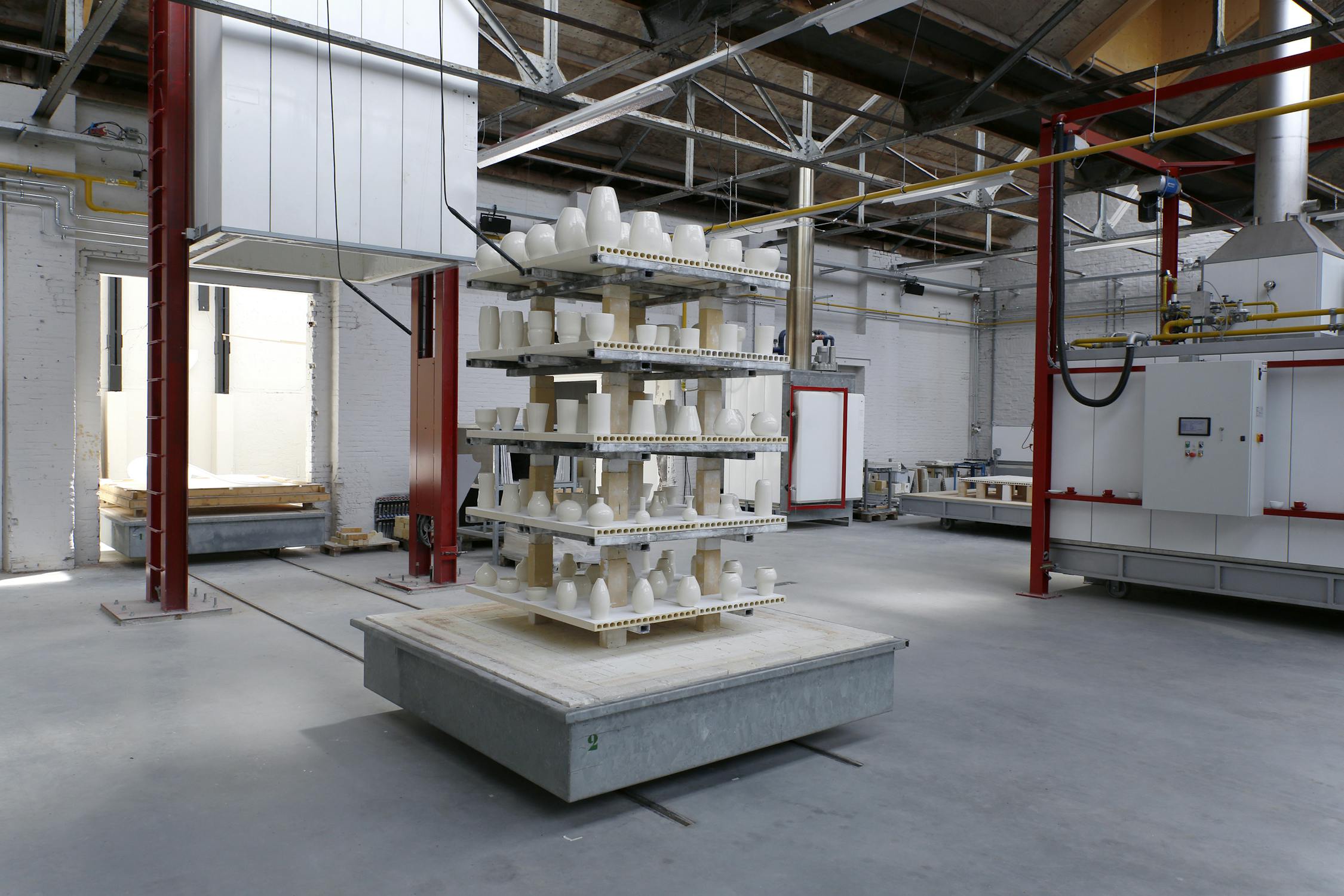
The following year, at the building’s official opening, EKWC’s kiln #2 and 109 freshly fired pots performed Paulien’s piece Would You Tell Me, the ethereal sound of crackling glaze filled the kiln hall to enchant the audience. She had noticed the ephemeral tinkling in the ceramic workshop of the Rijksakademie, and her first attempts to reproduce this fleeting experience had led to an invitation by then-EKWC-director Ranti Tjan to create a work for the opening in Oisterwijk.
Paulien likes to turn the accidental – unintended events – into an almost transcendent moment, when the material world appears to speak to us directly. This is what she did at the Muziekgebouw in Amsterdam, for instance, where five interventions in and around the building make the public areas sing In Fis to the receptive visitor, who is indispensable for the sound to occur.
Inner Swimmer, the book Paulien made, explores the relationship between body and environment in a different way. She created various scenes that start from a layer of fresh clay spread on the studio floor, that responds to subtle movements of the narrator's limbs. The photographs she made during the process capture the amazing moment when imagination and gesture are indistinguishable. The clay becomes a body of water, a wave, a breath, or something else entirely – that’s its nature: it can be anything, it can be nothing.
For one scene, Paulien returned to EKWC to pour casting slip on a bedroom floor and catch a cloud drifting past the window, reflected in the clay. Together with the text she wrote, the photographs form a story. “Inner Swimmer is a poetic interpretation of the inner path we follow as an idea takes shape,” the publisher’s website says. It's a modest description for such a tour de force.